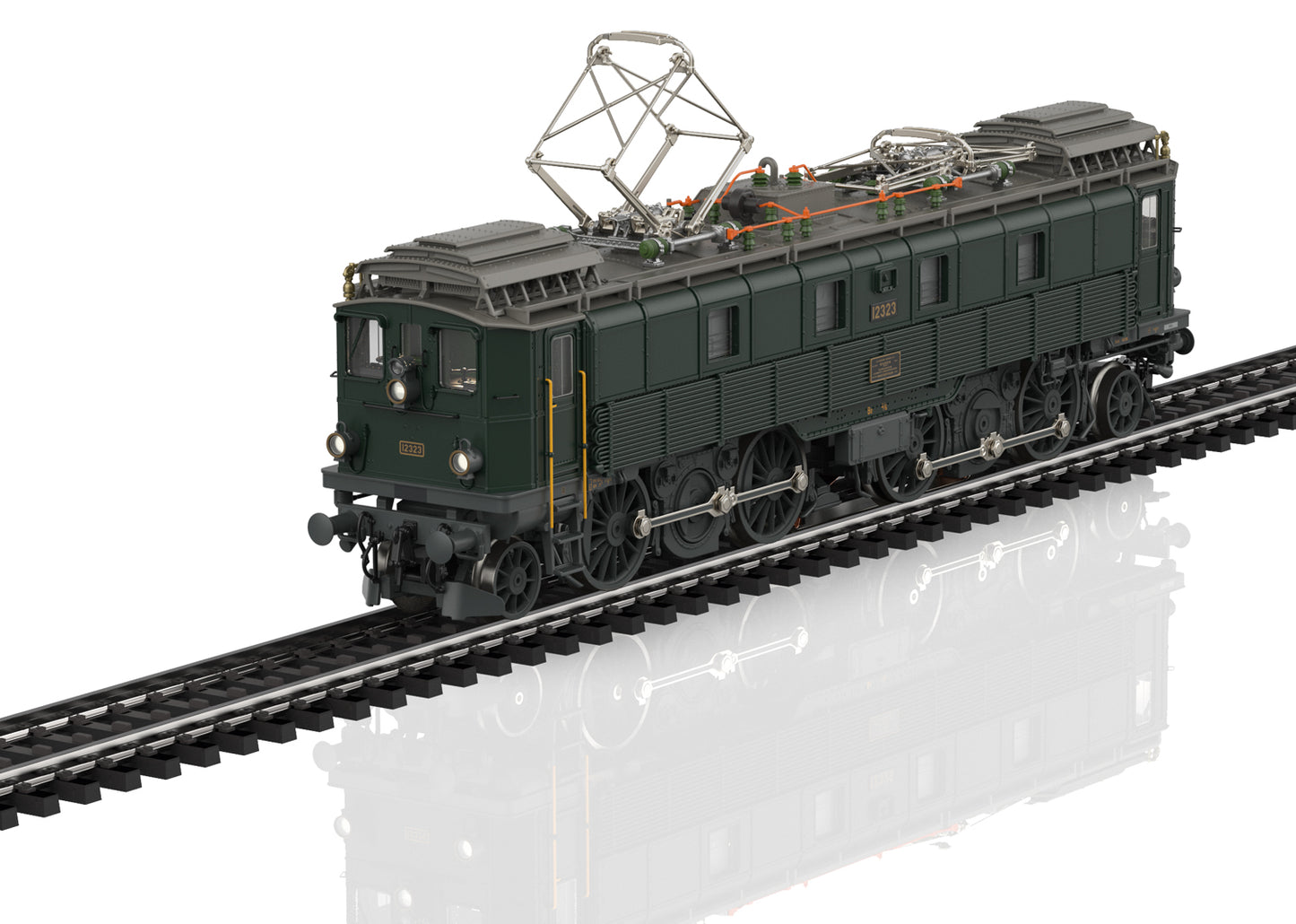
Marklin HO 39513 SBB Be4/6 Electric Locomotive Green IVa Summer 2026 New Item

Product description
Model: The locomotive has an mfx+ digital decoder and extensive sound and light functions. It also has a controlled, high-performance motor with a flywheel, centrally mounted. Both driving wheels and the jackshaft in each truck are powered via cardan shafts. Traction tires are fitted. The chassis is articulated to negotiate sharp curves. The triple headlights and one white marker light (Swiss headlight/marker light code) change over with the direction of travel, will work in conventional operation, and can be controlled digitally. When the locomotive is running “light,” the lighting can be changed to one red marker light. The oncoming train light can be controlled separately in digital operation. The headlights at no. 1 and no. 2 ends can be turned off separately in digital operation. There is a double “A” light function. There is also cab lighting and engine room lighting, which can each be controlled separately in digital operation. Maintenance-free, warm-white, and red LEDs are used for the lighting. The model features highly detailed metal construction with many separately applied components, such as cooling lines for the transformer oil. The cabs and machine room have interior details. The groups of driving wheels are fitted with sanding systems. The model features detailed roof equipment with heating resistors, roof conductors, insulators, lightning arrester coils, and roof walkways. The minimum radius for operation is 360 mm / 14-3/16". Brake hoses, imitation screw couplers, and steps are included. Length over the buffers 18.9 cm / 7-1/2".
In June of 1917, the SBB ordered two test locomotives (road numbers Be 4/6 12301 and 12302) from the Swiss industry for use in its electrified heavy express and passenger services on the Gotthard line. While the test locos were still being built, the SBB decided in May of 1918 to place a first modified regular production order to SLM and BBC, which included road numbers Be 4/6 12303-12312. These represented a clear further development of the aforementioned road number Be 4/6 12302. As early as July of 1918, a first subsequent order was placed for road numbers Be 4/6 12313-12318, followed by two further orders in 1920/21 as road numbers Be 4/6 12319-12328 and road numbers 12329-12342. These first electric Gotthard express locomotives then took up their duties between February 1920 and April 1923. Their external appearance was defined by a box-cab superstructure on a sturdy frame reinforced at critical points. The frame was mounted, using a pivot bearing on both driving trucks, each with a Bissel pilot truck wheel set. Two traction motors in each truck sent power to a low-mounted jackshaft, which was connected to the driving wheel sets by simple coupling rods. By 1929, the class Be 4/6 locos were hauling all important express trains on the electrified lines and, of course, chiefly across the Gotthard. It was only then that the new class Ae 4/7 units began to make the field more competitive, and by 1938, the days of the class Be 4/6 units hauling express trains across the Gotthard were largely over. They now earned their keep pulling regional and freight trains, which finally came to an end in 1962 due to the increased use of the class Ae 6/6 locos. The class Be 4/6 units moved to somewhat “flatter” terrain and were assigned again to the depots in Biel, Lucerne, and Winterthur. However, they were starting to show their age because they required much more frequent maintenance and repairs. In April 1965, road number Be 4/6 12312 was the first to be withdrawn, but growing numbers of retirements in the following years opened up gaps in the time-honored Gotthard express loco. Road number Be 4/6 12339 became the last of the Mohicans when it was retired on February 29, 1976. Three units are still preserved: Road number Be 4/6 12320 underwent a major overhaul in 1975 after being retired and was restored largely to its original condition. It then served for many years as an operational SBB museum locomotive and now belongs to SBB Historic. After spending time as a memorial loco in Baden and an exhibit at the Lucerne Transportation Museum, road number Be 4/6 12 332 went to the depot in Erstfeld under the care of the SBB Historic Team in Erstfeld. After spending many years in Italy, road number Be 4/6 12339 was acquired at the end of 2009 by the “Association Swisstrain” and is once again in Swiss ownership at the depot in Le Locle.
| Control Unit | Mobile Station | Mobile Station 2 | Central Station 1/2 | Central Station 3/2 | |
|---|---|---|---|---|---|
| Headlight(s) | X | X | X | X | X |
| Marker light(s) | X | X | X | X | X |
| Electric locomotive op. sounds | X | X | X | X | X |
| Locomotive whistle | X | X | X | X | X |
| Direct control | X | X | X | X | X |
| Engine room lighting | X | X | X | X | |
| Engineer’s cab lighting | X | X | X | X | |
| Whistle for switching maneuver | X | X | X | X | |
| Engineer’s cab lighting | X | X | X | X | |
| Sound of squealing brakes off | X | X | X | ||
| Headlight(s): Cab1 End | X | X | X | ||
| Headlight(s): Cab2 End | X | X | X | ||
| Blower motors | X | X | X | ||
| Letting off Air | X | X | X | ||
| Pantograph Sounds | X | X | X | ||
| Sanding | X | X | X | ||
| Rail Joints | X | ||||
| Brake Compressor | X | ||||
| Conductor's Whistle | X | ||||
| Doors Closing | X | ||||
| Coupler sounds | X | ||||
| Operating Sounds 1 | X | ||||
| Switching maneuver | X | ||||
| Special light function | X |
System: DC
Sound:
Country: Switzerland
Era: IV
Railroad: SBB/CFF/FFS
EAN: 4001883395135
Availability: Backorder
Couldn't load pickup availability
Share